UPVC door lock problems and how a locksmith fixes them
If you live behind a UPVC or composite front door, there is a good chance you have already met at least one of the problems in this article — a handle that suddenly needs real effort to lift, a key that used to turn smoothly and now catches halfway, or a door that seems to need a shoulder-barge to close properly. UPVC lock issues are among the most common jobs a UK locksmith deals with, and most of them come down to a fairly small number of causes.
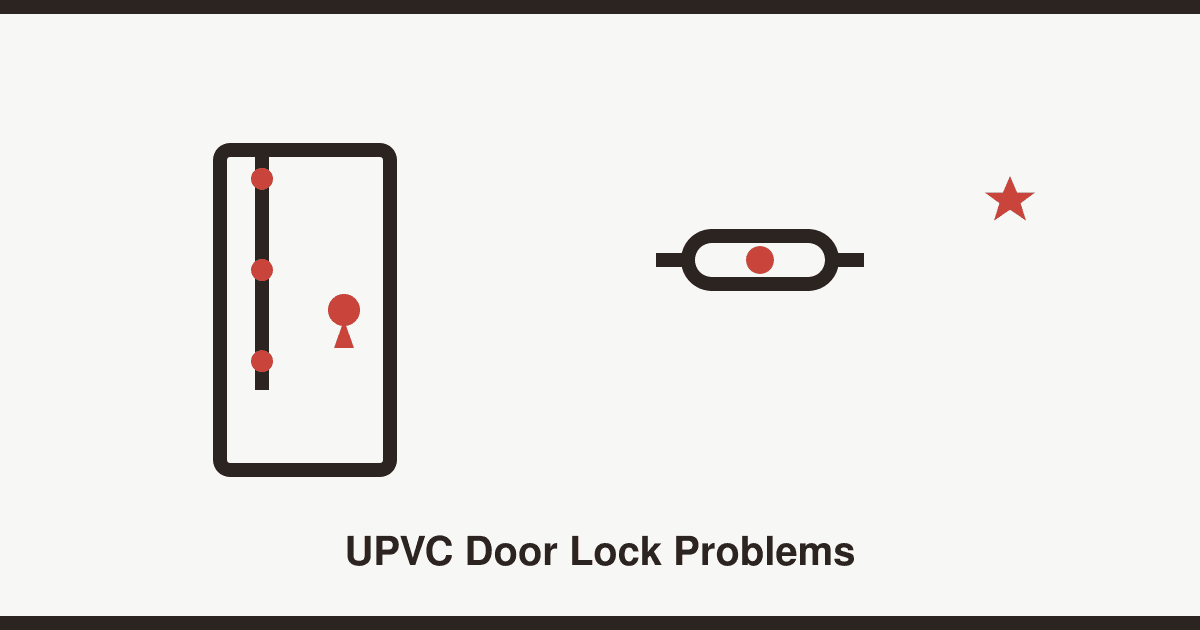
Unlike a traditional wooden door with a single mortice deadlock, most UPVC and composite doors use a multipoint locking mechanism: lifting the handle drives hooks, bolts or rollers into several points along the door frame at once, and turning the key then locks the whole system in place. It is a genuinely strong way of securing a door when everything is working correctly, with several points of resistance instead of one — but it also means there are simply more moving parts that can wear out or go out of alignment over time.
One of the most common causes of a stiff or difficult UPVC lock has nothing to do with the lock itself: it is the door dropping slightly on its hinges. UPVC doors are heavy, and over months and years the hinges can settle, leaving the door a few millimetres out of alignment with the keeps in the frame. The multipoint mechanism then has to force its bolts into position against resistance, which is what makes the handle feel stiff or the key hard to turn. A locksmith can often fix this simply by adjusting the hinges, rather than replacing anything.
If the handle lifts but nothing actually happens — no bolts moving, no resistance, just a loose feeling — the most likely cause is the mechanism's internal gearbox failing. This is the part of the multipoint lock that translates the handle's movement into the bolts extending, and it is a wearing part like any other mechanical component, particularly on a door used heavily every day. Replacing the gearbox, rather than the entire mechanism, is usually possible and considerably cheaper than a full multipoint lock replacement.
Keys can also simply snap in the lock, usually because the mechanism is already under strain from misalignment or wear, or because a worn key has developed a weak point. A locksmith can generally extract a broken key without damaging the surrounding lock, and it is worth treating a snapped key as a signal to have the mechanism checked properly rather than just replacing the key and hoping it does not happen again.
Separately from mechanical wear, there is a security problem specific to UPVC doors known as lock snapping. Standard euro cylinders protrude slightly from the door's faceplate, and this design was, for years, vulnerable to a technique where a tool is used to snap the cylinder in two at its weakest point, giving direct access to the mechanism inside — a method that requires no key and relatively little skill or time. It became common enough as a burglary method that the industry developed a specific rating system, TS007, to test and grade cylinders on their resistance to it.
TS007 rates euro cylinders on a star scale, with a 3-star cylinder representing the highest level of protection: these are built with a sacrificial weak section that snaps away without exposing the mechanism, along with resistance to drilling, picking and bumping. If your UPVC door is still fitted with an older, unrated cylinder — often identifiable by protruding noticeably further than a modern anti-snap cylinder — upgrading to a TS007 3-star cylinder is one of the more cost-effective security improvements a locksmith can carry out on a UPVC door, and it is a straightforward swap that does not require replacing the whole mechanism.
Simple maintenance can head off some of these problems before they need a locksmith at all: lubricating the mechanism once or twice a year with a light, non-oil-based lubricant designed for locks, rather than household oil, which can attract dirt and gum up the mechanism over time, keeps the moving parts inside the multipoint system running smoothly. Checking that the door still closes flush with the frame is also a useful early warning sign that the hinges may need adjusting before the lock itself starts to struggle.
Most UPVC lock problems, whether it is a stiff handle, a failed gearbox or an outdated cylinder, can be diagnosed and fixed by a locksmith without replacing the whole door mechanism. If your UPVC lock has been giving you trouble, our directory lists locksmiths covering towns and cities across the UK who work on multipoint mechanisms.
Frequently asked questions
This is very often caused by the door dropping slightly on its hinges rather than a fault with the lock itself. Adjusting the hinges to realign the door with the frame’s keeps can often resolve it without replacing any parts.
This usually points to the multipoint mechanism’s internal gearbox failing. A locksmith can typically replace just the gearbox rather than the entire mechanism.
It is a technique used to break a standard euro cylinder at its weak point to gain access to the locking mechanism without a key. It is a known issue with older UPVC door cylinders, which is why the TS007 rating system was introduced.
It is the highest rating in the TS007 standard for euro cylinders, indicating a cylinder built to resist snapping, drilling, picking and bumping — generally through a sacrificial weak section and other reinforced features.